
When Convenient Illusions Hold Precedence...
Language, Substance, and Money are intermediaries which crumble under weight of inspection

Whether it is language, substance, the self, or money, these representations act as convenient intermediaries, useful illusions, and when we attempt to ground them as a concrete foundation that is when we risk collapse of whatever constructs were built atop of them. Process Philosophy distinguishes itself from substances and products, to recognize the impermanent flux and space of potentiality which is ever present. Representations and products appear stable until they collapse, whereas processes have a different kind of impermanence, one that doesn’t pretend to be a constant and reliable foundation. In this article, I will explore the socioeconomic sleight of hand which has convinced us to place both feet firmly on these representations, and in so doing has pulled the rug from under us.
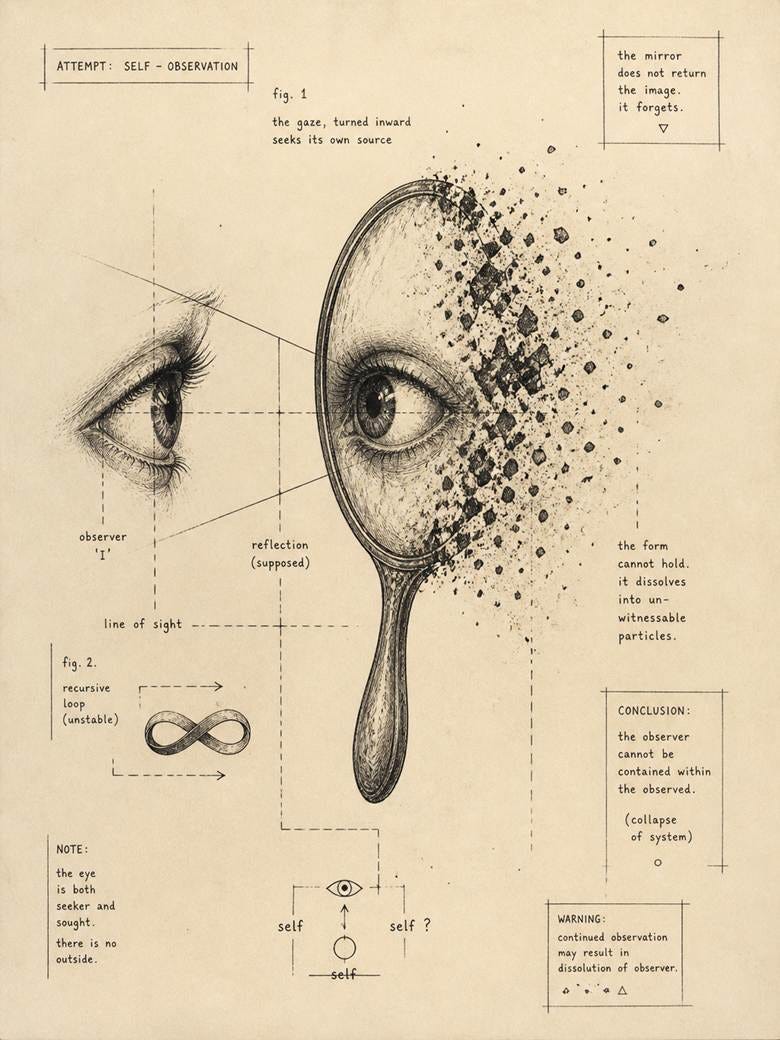
Ian McGilchrist, a Process Philosopher studying the divided mind, exquisitely shows how in any task both sides of the brain are involved but the Processual-Right Hemisphere has both the first say and the last, with the Product-Oriented Left Hemisphere acting as an intermediary by representing information. It is an illusion in the sense that it is prolonging a mental object that is not present, but re-presented in order to categorize it. Money acts as an intermediary between strangers, and forms the basis on which our socioeconomic system stands, it mediates the relationship as an intermediary not only between strangers, but between individuals and nations. A Product is also intermediary in the sense that they serve no purpose unless they are being used. This is problematic when there is an increasing tendency towards productivity, modernity has conveniently turned an increasing amount of the human world into products instead of processes, and hence created fragmentation and lack of social integration and interdependence. This is central to not only our sociological crises, but our psychological and ecological ones aswell.
The socioeconomic sleight of hand is partially due to our assumption of the neutrality of our value system. However it is now clear that there is a bias towards products over processes, such that we can refer to most socioeconomic systems of the past as Product Economies. These Product Economies are, failing to coordinate and promote relational processes that cannot and should not be measured, such as care work, education, ecological restoration etc. In its ideal, our value system should reflect what society collectively deems important, what we aim to reinforce, and what is meaningful. That is if it could be unbiased, and at the very least, it should encompasses what can be verifiably measured. Let’s define our value system as “A society’s agreed-upon measure of what is meaningful.” However, meaning is not something we can explicitly describe or dictate to others; rather, it is something we actively create. Value is a Product of meaning, where “meaning” is a dynamic process we enact. Defining a value system requires careful discernment of what is meaningful in any given context, and will necessarily change in any given context. John Vervaeke, concludes that while we can’t create a science of objective meaning or relevance, we can establish a science of Relevance Realization to unravel the intricacies of how we make meaning.
From a socioeconomic standpoint, Money is a communication technology, albeit slow, low fidelity and corruptible compared to modern communication methods. It should be an emergent collective measure and book keeping device for resource management used as an intermediary, always oriented towards the tangible purpose it is intended to serve. But we have inverted our orientation such that money became the goal in and of itself, and in so doing it no longer serves to signal resource availability. This is known as Goodhart’s Law which states that “When a metric becomes a target, it ceases to be a useful metric.” Money is long past this point, but there was a precise moment in recent history where our value system inverted on itself. Mariana Mazzucato, in her book The Value of Everything (Mazzucato, 2018), outlines three historical shifts in economic paradigms in which our Theory of Value was reconfigured as follows.
Classical Political Economy (18th –19th c.)
· Value pinned to: productive activity (labor transforming nature)
· Value creators: farmers, workers, industrial producers
· Value creation vs rent extraction (landlords, monopolists)
Neoclassical / Marginalist Economics (late 19th–20th c.)
· Value pinned to: subjective utility expressed through prices
· Value creators: no longer defined — markets reveal value.
· Prices replace production as the measure of value.
Financialized Economy (late 20th c.–present)
· Value pinned to: income generation and asset appreciation
· Value creators: finance, platforms, IP holders
· Value creation equals revenue, regardless of social productivity.
With each shift, value moved further from relational and material transformation toward abstraction and representation. Price came to stand in for value, and revenue for contribution. Mazzucato describes how this shift from an objective to a subjective basis of value results in value revealing the price, rather than price revealing value. The economy increasingly optimized what could be measured rather than what sustained ecological and social systems. This conceptual shift coincided with the structural transformation brought about by the Industrial Revolution. Prior to the Industrial Revolution, our economy was demand-driven, struggling to meet demands with a limited supply. After the Industrial Revolution, we transitioned to a Supply-Driven Economy, where overproduction necessitated the creation of artificial demand.
As John Maynard Keynes predicted in 1930, technological progress had the potential to dramatically reduce the workweek, yet the productivity gains that might have supported reduced working hours were instead directed towards cost reduction and market expansion. The cultural mechanisms necessary to sustain this transition did not arise spontaneously. Figures such as Edward Bernays transformed advertising into a systematic effort to manufacture desire and invigorate a new level of consumerism in a society that was otherwise content with what it had. Spending money was promoted as a social good to maintain employment and economic vitality. Other studies that point to happiness levels which plateau at a given salary also point to the fact that Product Economies are intermediary. They sustain the lower levels of Maslows Hierarchy of needs, but again extrinsic rewards cannot bring one to actualization. Motivation must be on meaning and concern rather than status and desire. Given relative material abundance generated by the Product Economy, we had, and still have, the opportunity to shift into a Process Economy, but we must orient not to productivity but towards proactivity grounded in expanded concern beyond our individual needs but to collective ones.
In my soon to be published book, I tease apart the distinctions between a Product Economy and a Process Economy, founded on meaning instead of value, concern instead of desire, commons instead of private property, relations instead of transaction, and participation instead of representation. It can be thought of fairly analogously to James P. Carse’s distinction between Finite Games or Infinite Games, but in regards to our human collectives. Importantly it is a parallel system, one that has already existed as it is the tangible relations on which our society functions. The infinite game is how Life on this planet operates, we have simply forgotten about it. The Product Economy is based on, and thus reifies, not only physical goods as products, but money, relations, and self identity as products. The Process Economy invites us to release our grasp on Finite Games to attempt to collaborate, coordinate and orient towards the infinite game in hopes of moving beyond our contemporary Meta Crisis.
As I’ve argued in “Representation Vs. Reality: Why we need a Process Economy Now!” the monetary system and product economy operate within the separation and power vacuum between the individual and the national scale as it is precisely the scale differential in which individuals become representations, in so doing it actively subverted agency of the local scale. The locality has been the central unit of humanity since our inception and yet for some reason we see very few autonomous local bioregions throughout the rise of modernity. In the proliferation of modernity, neoliberal capitalism appears to be expanding across the globe with the Dollar, Yen, Bitcoin and even Carbon, in their own way, attempting to become a global currency within a Global Finite Game. The worry is that we will double down on Finite Games as we approach questions of global interdependence and global risks. I will argue that the global game must be a Process Economy as it is incompatible and catastrophic to treat Earth, all its species and every human relation as a product or capable of valuation and representation. Finite Games by definition come to an end, and thus if our global civilization continues to conform to a Singular Finite Game without variety, then we approach global existential risk.
It seems that our psychological, sociological, and ecological crises, may be from a narrow worldview grounded in substance not relation, and without shaking this assumption Modernity may be stuck in the intermediary, unable to return to process. As Finite Games are intermediary moves within an Infinite Game, there must always be a return to process, where the game ends and we release our grasp on orientation towards the goal, we forget about the game, and its value system does not animate our lives anymore. When the basis on which we claimed a grounding, or on which we claimed was a viable lever of control vanishes, or when the future world we expected to arrive at falls away, we are left with a choice to reorient our attention.
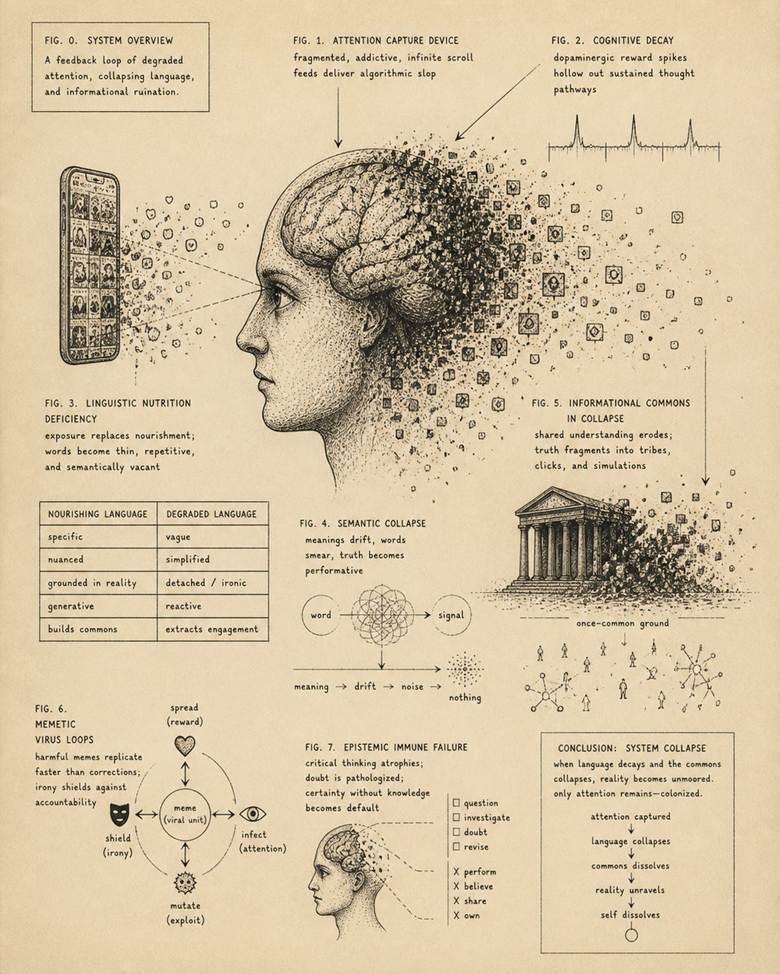
Anytime our orientation inverts to the intermediary, the representations on which we stood collapse under the weight. Take for example language and the internet, they are global commons for which we all rely but no one collectively owns. To the extent that we invert our orientation away from the meaning of language or the interconnection and awareness granted by the internet, but instead use language and the internet with a Finite Game mentality (whether as a means of control, influence or to saturate the information landscape with brainrot content), the meaning, relationality and connection found in those commons begins to erode. Mistaking the measure for the target, or allowing our attention and subsequent actions to be swayed by convenient illusions feels akin to an ouroborus that tragically undermines itself in search for progress.
There is currently a risk of such tragedy of the commons in these global systems in which we all rely. Moreover, the oceans, air, sky and global ecological systems are inevitably commons for which no one owns but everyone relies on. Insofar as they are interpreted as Products there will be GameTheoretic conflicts over them which deplete the commons. Again, the global scale must operate as a Process Economy as the infinite game is played through relationality. This is another way in which products serve as intermediaries, as the local commons operate as relational processes, thus as we scale our focus to the globe it must return to process and be constituted by relational interdependence.
Whether our ultimate concern is on global existential crises, or our local communities the way forward is the same, we must learn how to embody and enact processes that build tangible relationships of trust founded on concern. Our focus shifts from transactions to relations, and from such concrete experiential knowledge we can begin to find commonalities in stewarding the commons at any scale. One way or another it seems that the monetary system is not viable, the choice is whether we wait for it to collapse, or we coordinate proactively within a Process Economy which can relieve the pressure we put on the Product Economy such that we can transform it into a regenerative and sustainable resource management system.
You can visit MarcusBarrick.com to get notified when my book launches and get a poem inspired by the book when you subscribe to the newsletter.